 In honor of the 60th anniversary of the premiere of The Hollywood Squares (its first episode aired on NBC on October 17th, 1966), I'm doing something I haven't had occasion to do for a while: feature the board game version of a classic game show.
In honor of the 60th anniversary of the premiere of The Hollywood Squares (its first episode aired on NBC on October 17th, 1966), I'm doing something I haven't had occasion to do for a while: feature the board game version of a classic game show.
 |
| Family Feud set from 1976-1981. Art by "wheelgenius" on Deviant Art |
Especially in the years since COVID-19 lockdowns, I've found myself gravitating to British game shows that are available to me despite living in the United States. One such show, Pointless, has been running for over a decade now, despite being all-but unknown here.
The premise is that, before the show, 100 people are surveyed with questions. Unlike Family Feud, they're not looking for opinions, but rather how many of those 100 respondents can give correct answers. The contestants on the show are then asked the same questions, and seek to respond with answers that the fewest survey respondents could get right. Points are awarded for each respondent who got it right. For example, if asked to name a capital city in Europe, you might answer "Paris" (the capital of France). In the case of this survey (conducted in the UK), 98 people in the survey said "Paris," meaning you'd score 98 points, which really isn't very helpful, since that's practically everyone. But if the contestant instead tried something more obscure like "Stockholm" (the capital of Sweden), the score would be a much more attractive 30 points, since only 30 people in the survey could come up with the more obscure answer. What you really want is an answer like "Sarajevo" (the capital of Bosnia and Herzegovina), because that answer is both correct and one that no one in the survey group could come up with, rending it "Pointless," not only scoring zero points, but adding money to a jackpot that can be claimed by the winners.
But beware! If a contestant gives a wrong answer, they're hit with the full 100 points representing the entire surveyed group. Lowest scores win.
If you'd like to see the actual show, you can find an assortment of episodes at either YouTube (free) or BritBox (if you have a subscription). (I'm assuming a US audience. If you're lucky enough to live in the UK, you can get everything for free with iPlayer!)
When I was asked to help close out the college year with a game the faculty might play along with, I had to adapt the game play of Pointless a bit to accommodate an auditorium of potential players, but the basic rules are the same. You can watch the video below. The first several questions even come from books published for UK Pointless fans, while the last couple come from surveys we conducted at the college. I hope you enjoy the game!
As long-time readers already know, I'm a big fan of game shows, and over the years have accumulated not only a significant collection of physical game show home games (many of which have been featured here in the past. Just click the "game shows" label on the right-hand sidebar to see them), but computerized front-ends that allow me to host games as well. I've gotten a few of these on video to show off. This particular edition of "Family Feud" was hosted as part of a college kick-off event held online during COVID lockdowns a few years back. I pitted the STEM department chairs against the Humanities department chairs.
How did it work out? See for yourself!
 I've been enjoying watching (and re-watching) some of my favorite classic game shows on the 2-year old Buzzr network. If I have any complaints about the network at all, it is the simple fact that, although they theoretically have access to the entire FremantleMedia library of shows (reportedly over 40,000 episodes worth), the actual content shown rotates through a tiny fraction of that, which repeats more-or-less monthly (with occasional refreshes a couple of times a year). Naturally, this means that fans regularly ask Buzzr to air shows not currently available on the network. Concentration is one of these frequently-suggested shows.
 Five years ago, when I did a feature on the board game version of the original Password, I promised to do a future post on Password Plus. I didn't expect to take five years getting to it, much less to have moved to a new blog in the meantime, but the future is finally here!
 As I've pointed out in the past, I'm a huge fan of game shows. Easily my favorite genre of television. I was extremely pleased to learn last year, while I was between jobs, that BUZZR, a new free over-the-air broadcast station (i.e., not cable or satellite, which I would have to pay for) dedicated to classic game shows, was beginning to air in my area. BUZZR just celebrated its first anniversary earlier this month, but I'm more interested in another anniversary, which I also learned about through BUZZR: Friday, July 1st, marks the 75th anniversary of the television game show!
 With Thanksgiving around the corner, it seems appropriate to pull out a game that has been something of a family tradition for quite some time. In fact, this is arguably the start of my game show board game collection right here.
 For those unfamiliar with the game (and if that's you, thank you for bearing with me on a post that you must have no interest in whatsoever, since anyone who follows game shows probably knows Family Feud pretty well!), the object is to guess the most popular answers to survey questions posed to 100 people. For example, in the example in this picture (go ahead and click for a larger version... and zoom in if you need to), the question was "Name something that a dog wears." Points are scored according to how many of the 100 people surveyed gave a particular answer (with the highest-ranked answers showing up at the upper-left of the survey, and working downward through the four answers — in this instance — that got more than a single response).
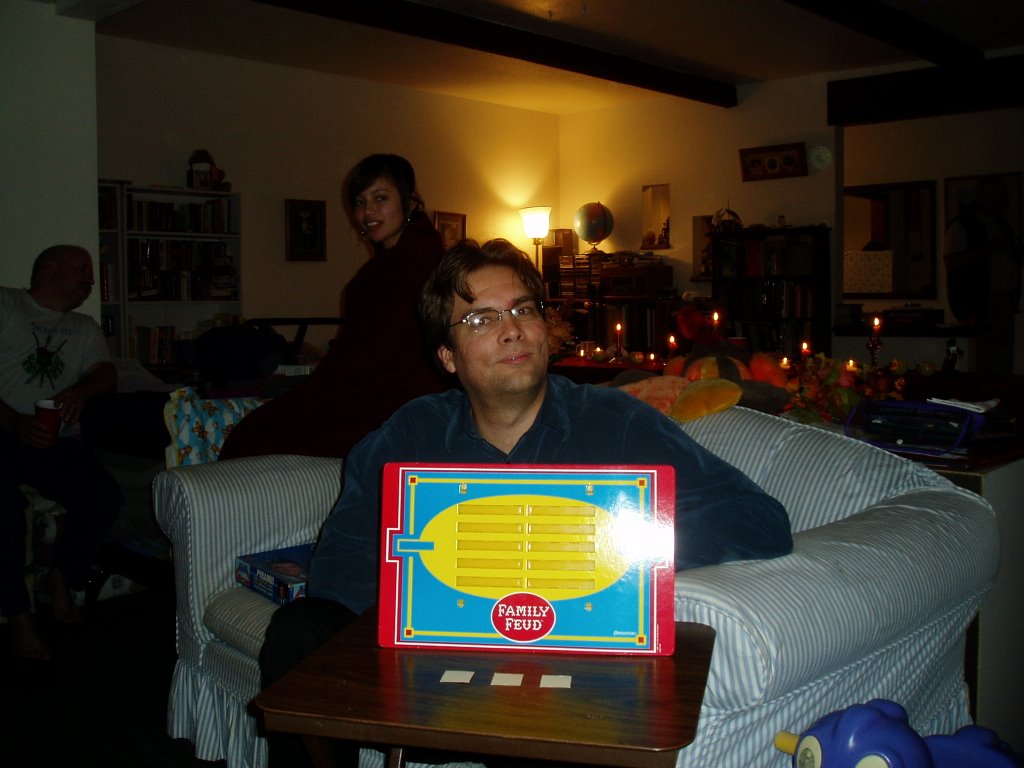 Allowing for the lack of electronic precision provided by the buzzers and timers of the actual show (although these may, of course, be provided by other means with the proper resources... like that otherwise terrible electronic version of the game from 1998), the board games duplicate the play of the show almost perfectly, and Family Feud is arguably my favorite board game to "host" at a party. My only real difficulty these days is a side effect of the fact that these editions all came out 20 years or more ago. Imagine asking someone today to "Name a famous person named 'Bill'," when all of the answers on the survey were originally given in the 1980s! Bill Clinton's not going to be there, even though it might well have been a contender for the number one slot today.
 Card Sharks is one of those shows that's due for a proper revival. It's now been 13 years since the most recent version was on the air (which, itself, is about how long it had been between the most recent version and the one that came before it). This version of the board game is dubbed the 25th anniversary version, despite coming out just a touch early (in 2002. The show premiered in 1978). It's actually a bit unusual among game show board games in my collection, in that it was sold without any version of the show currently on the air.
 By the time this home version made it to store shelves, the most recent version, which lasted for one season in 2001, was already gone. Oddly enough, although this board game does indeed incorporate the logo and basic sense of style (or lack thereof?) from that version, the way the game is played bears pretty much no resemblance to the 2001 show, but instead incorporates elements from the previous (and much more successful) incarnations. This is classic Card Sharks.
 The winning player now gets to play the "Money Cards" bonus round, using the reverse side of the game board. The player starts with $200, and bids any or all of that amount on whether the next card is higher or lower, and continues in sequence for each card that comes afterward with whatever money is won or left over (adding $400 after the end of the first row, as that card moves to the next level). Finally, for the last card of the round, the player must make a "Big Bet" of at least half of their Money Card winnings.b
 Yesterday came and went without much fanfare, but Jeopardy! reached a milestone. Fifty years have passed since the airing of the first episode.
 The original version of Jeopardy! only lasted for nine years. There was also a syndicated version that lasted for about a year (simultaneous with the end of the original run) and a revival that, itself, lasted for only about five months just a few years after the original ended. Nonetheless, the fact that Art Fleming had hosted all of these versions meant that there was a fair bit of controversy when he was passed over for the 1984 revival in favor of Trebek, who at the time had hosted a sizable handful of shows that never seemed to last very long. Now, thirty years later (and nearly two decades after Fleming's death) game show fans can see that Trebek and Jeopardy! were a perfect match for each other. With Trebek presumed to retire in another couple of years, speculation is already high about what the future of Jeopardy! may look like. For now, it's time to celebrate!
 Dating back to 1961, Password is probably the game show with the deepest roots to have a version aired within the past decade. The first board game version came out in 1962, followed by many, many editions over the years to come. I won't swear that my version is a "first" edition, although it does have the 1962 copyright and does not indicate a later edition as many later editions did.
 The original Password was a very simple game, and thus easily emulated in a board game. Four players compete in teams of two. Although one can designate an additional person to serve as "host" to distribute the cards, the board game doesn't require this. Basically, each team has an "A" player and a "B" player, and having decided which of the twelve sets of pre-assigned word cards to use, the "A" players of competing teams are given the "A" card for that number, while the "B" players get the "B" card for that same number. The cards are placed into the sleeves so that the first word appears through the red-filter at the top of the sleeve (red filters really were fairly common in game show board games once upon a time).
  As the show itself regularly announced, "it's the crossword game you've played all your life, but never quite like this!" Scrabble has certainly not been the only game show to spin out of a popular pre-existing board game, but I daresay that it was one of the more successful, lasting for nearly six years in its original run (and earning a second run a few years later that admittedly only lasted a few months). Oddly enough, the game was changed so significantly from the original Scrabble that a separately-sold "TV" version was pretty much a necessity if one was to try to play this version at home. Just having a regular Scrabble set just wouldn't cut it.
 I actually put off getting this game when it was originally on the market, because I just couldn't see how the game board I'd seen advertised, a red-filter affair of the type not uncommon in game show board games (I've already featured one example here on the blog with Jeopardy!), could possibly be used to emulate the feel of the show, which doesn't use any similar prop. Yet once I finally got this version off of an eBay auction several years ago and finally had a chance to look through the instructions, I found that it actually does so remarkably well.
 "Get ready to match the stars!"
 Last week, I featured the 1950's version of the Tic-Tac-Dough board game. This week, I'm discussing the 1970's version, which like the original version, seems to have come out roughly around the time of the show's premiere (1978, in this case, although the copyright actually says 1977 for some reason). The game play of the new show was rather similar to the original version, although they changed pretty quickly from shuffling only after both contestants had been asked a question to shuffling after each question. Also, center-box questions on the show became routinely two-part questions, as opposed to merely "more difficult" than other questions (although like the original, extra time was allowed for the contestant to consider a response).
 There's little point in denying that the 1970's board game itself is considerably cheaper than the 1950's version. Instead of mechanical gears and a lever to shuffle the categories, the 1970's game settles for a mostly cardboard affair, using numbers for categories on a single rotating disk. This does, however, have the benefit of easily allowing for different categories in each game (I'm under the impression that one was supposed to order accessory kits to add new categories to the 1950's game, but I've never seen that these actually exist).
 I've featured a few game show board games on this blog in the past, and it's high time I got back to doing a few more. This time, I'm going to feature the oldest such game in my collection: a 1956 or 57 (my sources differ on the year) edition of the game created for the original Tic-Tac-Dough. Jack Barry (later known to my generation as the host of The Joker's Wild before his death in 1984) is featured on the cover, and was indeed the original host of Tic-Tac-Dough. But since Barry was only host of the show for a few months in 1956, it seems reasonably likely that he had already moved on by the time this game would have been available.
 The board game really captures the feel of the actual show rather brilliantly. I'm especially impressed by how the board game duplicates the mechanism for shuffling categories, almost precisely scaled-down from what was done on the 1950s-era set. The categories are shuffled by pulling down on the blue lever to the right. The questions are contained on a series of cards held in a blue stand. While this means a lot of potential parts to be lost, it is much closer to how an actual quiz show host gets his questions than the standard "question book" that most game show board games of a later era would have.
 I don't watch Survivor as much as I used to. Back during the second season (I didn't see any of the first), Survivor was appointment television, and I joined a group of my friends around the television set every week to watch, and to talk about what we all thought would happen next week.
 On the comparatively rare occasions when I am with a group of friends playing board games at their house, it seems that Taboo is almost always requested. I usually am pretty happy to join in, because I know the truth: Taboo is pretty much the same game as one of my favorite game shows, which in the 1980's I knew as The $25,000 Pyramid!
 Pyramid captures the gameplay of the game show quite nicely (although it's rather difficult to have teammates trade off in the middle of a round, given the fact that all clues for that round are visible on the side of board available to the players giving them), if perhaps it doesn't capture the snazzy feel of the set with the rotating trilons anything near as well. Instead of a digital timer, you are given an hourglass with bright pink sand in it (a fairly common element in board games with a timed element). The hourglass is remarkably well-calibrated to the expected 30-second time limit required for the regular game. Unfortunately, only one hourglass is provided, requiring someone to flip it over in the middle of the 60-second "Winner's Circle," which is more than a little unfortunate. As anyone who's watched the show can attest, this round can be quite intense, and one really can't expect the players to be paying attention to the clock when they're trying to win the round!
 Game shows have been a part of American culture for a rather long time. Thanks to the fact that so many older programs, especially those made for radio before the 1970's, have fallen into the Public Domain, it is relatively easy to enjoy some of these pieces of game show history even today.
 You Bet Your Life was a game show that was more about the "show" than the "game" part. Premiering on radio in 1947, and eventually being broadcast on both radio and television in 1950 (indeed, the very same episodes aired in both media, thanks to the simple format), the show starred movie legend Groucho Marx. Groucho had a skill for improvisation that was unmatched, and many of the Marx brothers most famous comedies were largely ad-libbed. This skill was put to good use on You Bet Your Life, which featured Groucho and three pairs of contestants in each show. The contestants were often (but not always) selected from the studio audience, and often were not people who knew each other, but who fit "categories" requested by the producers. One pair, for example, featured a "hobo" alongside a "job analyst." Groucho and the couple would chat for a few minutes, before eventually playing the perfunctory game, whereby the contestants would answer a series of questions, betting a portion of their existing winnings (starting with $20, at least in the earliest episodes) to try to accumulate the highest total at the end of four questions. The couple with the highest total then attempted to answer a single question at the end of the show for an escalating jackpot (starting at $1000).
Groucho: "What sort of work do you do now?"Other game shows have been known as much for the humor they generated as they have been for big cash prizes. The 1970's classic Match Game, for example, would never have been a hit if not for the antics of the celebrities and the double-entendre jokes (mild by modern standards. In fact, this is why some suggest that the show couldn't work today. I disagree, but do feel that the more recent attempts to revive Match Game didn't understand that there is a boundary between what's funny what's going too far into the risque) often tossed in.
Mr. Thacker: "I don't work."
Groucho: "You're a bum?"
 Of all the game shows I watched when I was a child, The Joker's Wild was always my favorite. I'm not entirely sure that I can explain why. Perhaps it was the "pure trivia" nature of the game (although certainly simplistic compared to Jeopardy! questions today. But I started watching game shows in the few years between the end of the original Jeopardy! and the beginning of the current version, so I wouldn't have known that yet), maybe it was the hosting (Jack Barry at first, making his big comeback from the game show scandals of the '50s--something else I didn't know anything about at the time--and Bill Cullen in the couple of years after Barry's sudden death), but I'm guessing it was probably the fact that the game centered on a "slot machine" with three spinning wheels that determined the categories. I've always been a sucker for game shows with wheels!
 Naturally, when I grew up, I had to add to my game show collection the board game version of The Joker's Wild, produced by Milton Bradley in three editions (plus a child's version, patterned after the children's spin-off Joker! Joker! Joker!) starting in 1973 (the year after The Joker's Wild premiered). I suppose that this game duplicates the mechanics of the actual gameplay as well as could be expected for an affordable home game using 1970's technology. The main board looks enough like the slot machine from the actual game, but instead of three separately spinning wheels, the categories are determined by a deck of playing cards. Instead of actual category names (as seen on the show), the cards have numbers on them, intended to correspond to one of 5 categories as read from a little booklet (although I do like that the booklet of categories is separate from the booklet of questions and answers, allowing players to see the categories for themselves without spoiling the game). But I have to confess, cards are a poor substitute for actual wheels. And the odds of getting matching categories out of the cards just has to be different than the odds of the same result from independently spinning slots... but I digress.
 Bonus rounds are perhaps a bit superfluous in a home game, since prizes are seldom actually given away when playing at home. Still, it does help to create the feel of the game show. Unfortunately, the board game duplicates an early version of the bonus round that I never actually saw as a child (being born in 1974, the game had evolved a bit before I was old enough to remember watching). However, I would argue that I like the way the cards emulate the slots better in this round. You are given three separately-colored decks of cards, each corresponding to one of the three slots on the slot machine. The cards in each deck are exclusively images of jokers, plus one "devil" per deck. The player starts the bonus round by playing one card from each deck. If all three cards show jokers, all is well, and the player is awarded $100. The player can stop right there and take the winnings (again, this is a bit of a moot point at home, where it's just play money), or risk that money to try again with the next card in each deck. Another set of three jokers increases the players' winnings to $400, and the player can stop there or risk it all to try again. A result of three jokers one more time increases the winnings to $1000, and the game ends. However, if a devil appears at any time, on any of the three decks, the bonus game is over and the player wins nothing.
 Given that Jeopardy! has a history dating back more than 45 years, it's probably no surprise that there have been a lot of home versions produced. Of the board game versions (that is, not counting any fully-electronic versions or various versions one might play on one's television set), I think the 1999 version by Parker Brothers is definitely the best.
 Since the television version of Jeopardy! has always had six categories per round since the show's beginnings in 1964, the fact that no version had included a board with six categories previously may come as a surprise (TYCO did a couple of versions of Jeopardy! in the mid-1990's that used six individual category stands, rather than a single board. This allowed for the correct number of categories, but had a rather different aesthetic and play pattern entirely.). But take a moment and do the math on those dates. It took board game designers 35 years to make a Jeopardy! board with space enough for six categories! For some reason, all previous versions of the board game--and all versions made since--have used boards that only had five categories per round! (Pictured here is the 9th Milton Bradley edition, which I believe is from 1972.)
 EXTRA: If using all that funny-colored play money is too unwieldy for you, perhaps you might want to use the "Jeopardy! Challenger." This little hand-held device from 1987 is basically just a glorified calculator designed to help fans keep their own score while watching the show. My grandma found this one for me a few years back, and this seems like the best time I'm ever likely to have to mention this interesting and hard-to-find collectible, although, to tell the truth, I generally just use a pen and paper, anyway (both for watching the show and for keeping score on the board game versions).